
How to Find a McDowell Property Owner
The cleanest path runs from address to card to deed. Choose McDowell County in West Virginia Property Assessment and enter the situs address. An unclear address can be searched by owner name. A parcel key from a tax map also works. Open the matching result and copy its exact PID, owner or owners, and mailing address. Add the physical and E-911 fields, the legal description, and the book/page. Next, search the deed portal for that owner as grantee. Confirm the instrument matches the parcel description. If the roll and the newest deed disagree, note the assessment year. Then ask the assessor whether a transfer update is pending.
- Search the property address or known owner in the state assessment application and choose the McDowell result.
- Copy the owner(s), tax year, PID and book/page from the assessment card.
- Search the County Clerk index for the named grantee and inspect the latest deed that matches the legal description.
- Check whether a trust, estate or company name is the recorded holder; do not treat a related person as the owner without a deed.
- Use the assessor or Clerk to resolve a recent transfer or mismatched parcel reference.
The McDowell Assessor's Owner Field
On the assessment card, the owner line is labeled Owner(s). McDowell County publishes it as the assessment owner. It is tied to a tax year and a parcel ID. A sample Welch card lists SNOW CRAIG & REBECCA with book/page 645/539. The card also shows the site address, legal description, and value components. That line answers the tax question of who owns a property in the county's records system. It cannot tell you whether a later deed is still working through recording. Nor can it show whether every partial interest fits on one line.
Treat the owner field as a lead. Then compare it against the latest recorded deed. Some parcels list a school board or another public body as owner, not a household. The assessor field names a record holder, not the person living in the building.
The assessment card displays the owner and address fields in context: open the source Welch parcel card.
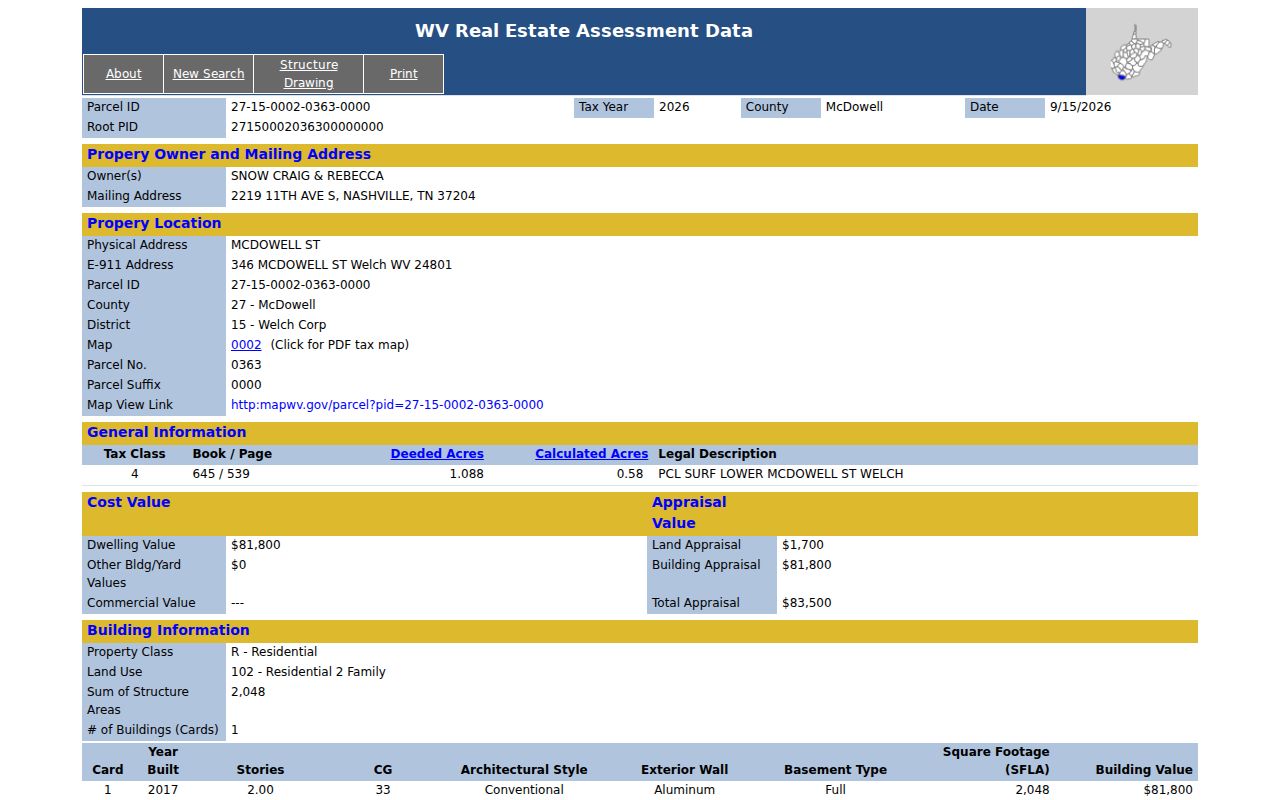
Use the book/page and PID as bridges to the deed index and map.
McDowell Sources for an Owner of Record
Each McDowell source answers a different question. The assessment roll supplies the owner(s) field, mailing address, parcel ID, tax class, and appraisal details. The Clerk's index shows grantor, grantee, and terms. The tax inquiry service settles a ticket question, and MapWV locates the surface parcel. No single portal covers all four. Use the owner field to find the card, the deed to verify the transfer, and the map to confirm the PID describes the intended parcel.
| Source | Owner Info It Gives | Access |
|---|---|---|
| Assessment roll | Owner(s), mailing address and parcel information | Public annual search |
| County Clerk deed index | Grantor, grantee and recorded transfer reference | Online index; older records have a separate path |
| Secretary of State entity search | Public filing information for a registered company | Free entity search; not proof of parcel title |
| MapWV viewer | Surface parcel location and map context | Public parcel viewer |
A listed owner can live somewhere else entirely. The mailing address may fall in another state, the parcel may sit vacant, and ownership may run through an entity. That address serves tax mail. Public property records name the owner of record, not whoever occupies the home today.
Separate a McDowell Owner's Mailing Address from the Property
The Welch sample shows why the two address fields must be read side by side. Its owner mailing address sits in Nashville, Tennessee. The physical address is McDowell Street. The E-911 address is a numbered Welch location. A War Corp school parcel flips the pattern, pairing a Welch mailing address with a route-style physical description in District 14. These are genuine McDowell record patterns, not a sign that an entry is wrong.
For the question who owns this property, use the mailing field only to see where tax notices go. Identify the land itself with the physical and E-911 lines, the PID, the legal description, and the GIS polygon. ZIP codes are postal labels. They do not define the municipal boundary.
Match the McDowell PID Before Naming an Owner
A McDowell parcel ID opens with county code 27. The rest identifies district, map, parcel, and suffix. Keep the full string, not a short map reference. The complete number separates two properties with similar addresses or owners. It also links the assessment card to a tax map or delinquent-land search. A district label like Welch Corp 15 or War Corp 14 is a useful clue, but the number itself is not a boundary certificate.
Check several fields before naming an owner. The PID, physical address, acreage, and legal description should all point to the same land. Disagreement calls for a closer look. Compare the deed date with the assessment year, and keep both parcel keys if the tract has been split.
Confirm the McDowell Owner in the Latest Deed
Start with the assessor card and pull the book and page shown there. Then go to the County Clerk portal and search the current assessment owner as grantee. Open the deed that matches the parcel and read it closely. The grantor and grantee names matter. So do the execution and recording dates, instrument type, and legal description. Treat book and page as a lead, not a finish line. A later deed may exist. If the first query comes up empty, try alternate spellings and search both party roles.
Two cautions come straight from the portal itself. Records still in processing may not appear, and the online index is not certified. When a recent closing is missing, ask the Clerk about recording status. Ask the assessor when the annual owner roll refreshes. For a deeper path through the index and older records, the McDowell deed-records guide lays out the full method.
When a McDowell Owner Is a Trust, Estate or Company
A McDowell deed does not always vest title in a living person. The grantee may be a trust, an estate, an executor, a trustee, a limited liability company, or a public body. Search the exact name in the Owner(s) field, punctuation and abbreviations included. The Clerk portal helps here. It separates people from companies, and it allows grantor and grantee searches in both directions, with FullText and SoundsLike modes for stubborn spellings. Probate and guardianship files can explain an estate transfer. But the recorded deed is still the direct land conveyance source.
For a company, the West Virginia Secretary of State's business entity search shows public filing information. That is useful context. It does not prove which individual beneficially owns a parcel. An officer or registered agent does not become the owner of record by virtue of that role alone. The deed controls.
When the McDowell Owner Roll Has Not Caught Up
The assessment site publishes its information annually. A recent purchase may take time to filter through. A deed can sit on record at the Clerk's office. The new owner may not show on the statewide card until later. Parcel lines move slower still. When a transfer changes a boundary, the assessor's update schedule governs when the map follows. Date any discrepancy rather than reading it as a failed deed. Note the tax year, the deed recording reference, and the date the card was viewed.
For answers, split the question. Ask the County Clerk about recording status and the assessor about the roll. The parcel may be certified delinquent. Add the State Auditor's current status and redemption process as another record layer. The current-owner guide centers on publication timing and how to confirm the present entry.
What a McDowell Owner Lookup Cannot Establish
An owner lookup answers a narrow question. The owner of record may not be the occupant. They may not be the mailing contact, or the beneficial owner behind an entity. A tax roll can lag a closing. An online deed index can miss an item still in processing. A lookup does not establish clear title, expose every mineral right, or settle where a surveyed line runs. West Virginia's Address Confidentiality Program adds one more wrinkle: protected participants use a substitute address. So a public mailing entry should never be assumed to reveal a residence.
For a person named on the card, treat the name carefully. It is the assessor's published ownership field for that tax year. From there, use the parcel's full PID and book/page. That will lead to the conveyance in the Clerk's records. When the card names a trust, estate, company, or several co-owners, preserve the exact vesting form. Check the instrument itself. Do not guess that a relative, trustee, or officer holds title individually. The public card is a starting point, not the final word.
Lawful use. Use McDowell ownership information for property research and due diligence. Do not use an owner name or mailing address to stalk, threaten, harass or harm anyone.