
McDowell Deeds and Other Recorded Instruments
Deeds in McDowell County rest with the County Clerk. The Clerk is the custodian of county deeds and official records. The deed portal indexes conveyances and a wide circle of related instruments. Deeds of trust, releases, plats, assignments, liens, and easements all sit in the same system. A deed names the parties. It records the terms of an instrument placed in the public record. It does not, by itself, prove that no other interest exists. It also cannot confirm the description matches a modern fence line. Read the legal description and recording reference together. Then compare the named parcel with the assessment card.
| Deed Type | What It Does | Common Use |
|---|---|---|
| Deed | Conveys the interest described by the instrument | Sale, gift or other transfer |
| Quitclaim deed | Transfers whatever interest the grantor has, if any | Family or title cleanup |
| Deed of trust | Records a security interest connected with a loan | Financing; search for release or satisfaction later |
| Release or satisfaction | Records discharge of a previously filed interest | Confirming a lien or security instrument was released |
| Plat, easement or assignment | Records a map, use right or transfer of an interest | Parcel context and rights affecting land |
A conveyance and an encumbrance answer different questions. A deed transfers an interest as the grantor describes it. A deed of trust, by contrast, secures an obligation, and a release may later show that obligation was discharged. The portal indexes numerous instrument types and abbreviations. Search the relevant party, then confirm the actual document. An index label is a starting point, never a legal conclusion.
Search Fields in the McDowell Deed Portal
McDowell's online index gives searchers several controls for older names and mixed property filings. Standard runs a direct index search. FullText can widen the hunt through document text where available. SoundsLike catches spelling variants that a precise match would miss. The portal also sorts by date or name and sets party and entity types. Start broad and note the result set. Then narrow by date, instrument type, or book and page. When a name is common, separate a person from a company. Switch between grantor and grantee until the transfer fits.
| Control | Available choice | How to use it |
|---|---|---|
| Search type | Standard, FullText, SoundsLike | Try more than one for scanned or variant names. |
| Party and entity | Both, Grantor, Grantee; Both, Company, Person | Set the role before retracing ownership. |
| Date and sorting | Begin/end date; date or name order | Use a range when one party has many filings. |
| Book reference | Book type, book and page | Test a book/page from an assessment card. |
| Instrument type | Checkbox list with legacy abbreviations | Look for deeds, maps, easements, releases and related filings. |
The portal's landing screen and its Indexes panels display the available search routes. Open the McDowell County deed search and accept the portal's disclaimer to reach the index.
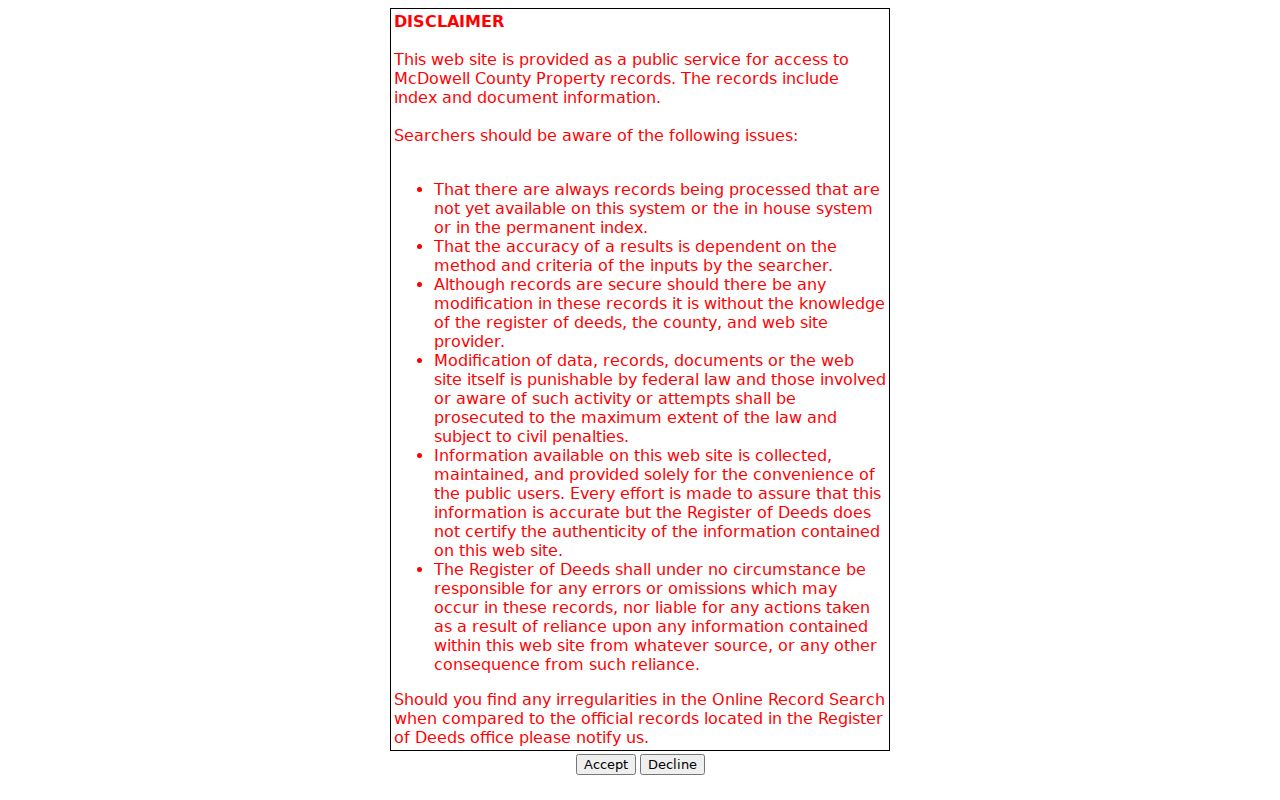
Read the portal's notice because it explains the limits of the online convenience data.
McDowell's Perryville-to-Welch Record Trail
Welch became the county seat after an 1892 election. The city was incorporated a year later, in 1893. County records were carried from Perryville toward Welch at night, in two wagons. The municipal history tells it that way to avoid violence. That story explains why a McDowell deed search belongs with the County Clerk. It also explains why a property history may mention an earlier community name. The present address may sit in Welch. So preserve references to Perryville, English, Coalwood, and nearby waterways while tracing a family or tract through the older books.
The incorporation date does not begin the deed chain. A parcel may carry older transfers, surveys, or company interests. Some were recorded before Welch existed as a municipality. Treat the current city name as a locator. Do not treat it as a substitute for the words in each historic deed.
The McDowell Grantor and Grantee Index
The grantor transfers an interest. The grantee receives it. The County Clerk index lets a researcher search either role. To follow a parcel forward, find the grantee on the transfer being checked. Then watch whether that name later appears as a grantor. To trace backward, start with the most recent grantee. Use that deed's grantor as the next name to search. Keep one result per transfer in date order. Verify the legal description belongs to the same land.
- Search the current owner's name as grantee and locate the likely acquisition deed.
- Read the grantor name and parcel description from the instrument, not only the index row.
- Search that grantor as a grantee to find the earlier acquisition.
- Repeat, switching name roles and modes when an earlier spelling or company form appears.
- When the trail crosses the portal's pre-1971 limit, continue in the Old Index Books and Non-Indexed Deed Images.
- Grantor
- The party transferring the interest described in a deed.
- Grantee
- The party receiving the described interest.
- Chain of title
- The ordered set of recorded transfers used to trace an interest over time.
- Book and page
- A volume and page reference to a filed record; compare it with the portal image and office copy.
McDowell Deed Records Before 1971
Deeds recorded before 1971 sit outside the main electronic index. The McDowell portal says so plainly. It points users to the Old Index Books and the Non-Indexed Deed Images. Treat the online search as a starting point only. Its separate image tree and non-indexed plat tree let you browse older material page by page. The West Virginia Archives holds McDowell deed and index microfilm. FamilySearch catalogs microfilm of the original records as well. Those are the documented fallback routes when a name search stops short.
Gather your tools before the older search begins. Write out likely owner names and spelling variants. Add location terms, the deed book and page from later instruments, and the parcel's legal description. A creek, mine camp, road, company, or old community name often beats a modern street address. When several books or images might match, ask the County Clerk which reference series fits your case. Ask the Clerk early if you feel stuck. The portal posts no copy or certification charges. Confirm those fees with the office directly.
The Archives finding aid documents a McDowell deed-index series beginning in 1842. Coverage varies by book and film across the record groups. Estate records run alongside it. The aid lists wills from 1893 through 1969. It also lists probate from 1897 through 1926 and fiduciary records from 1894 through 1927. Those series can explain why a personal representative or heir signs a later deed. They never replace the deed that moves the land.
Log everything as you go. Note the record series, volume, page or film reference, and the exact party name used. An index may point to a book unavailable online. Before assuming a gap in the ownership chain, ask the Clerk which office or repository holds that image. A probate entry gives context. Confirm the real property's passage in the recorded conveyance itself. Match its legal description to the current parcel.
Coalfield Names and Split Interests in McDowell
Coal and railroad names thread through McDowell property history. The surface parcel may sit apart from mineral interests or reservations within it. A modern assessment card and GIS view describe only the surface. They do not prove mineral rights are included. Keep company names and old community references in your notes. A former owner may have been an estate. It may also have been a dissolved entity. In either case, the deed chain may run through fiduciaries or assignments rather than a simple sale between individuals.
Compare the deeded acreage and legal description against each later instrument. A current map parcel can be one piece of an older tract. An easement or right-of-way may carry a different instrument type in the index. The recorded chain is the focus here. Use the parcel-map guide for the surface layers. Then bring a title professional in for a full title examination.
Why a McDowell Deed Search Can Miss an Instrument
Some items are still in processing. The deed portal warns they may not appear in the public system, the in-house system, or the permanent index. Its online data serve as a convenience copy. The Clerk has not certified them. Search terms matter too. A name may hide under another spelling. It may sit under a company rather than a person, or in the opposite party role. Run broader name modes before concluding nothing exists.
Sometimes a deed should be there but is not online. Contact the County Clerk at 109 Wyoming Street in Welch. Weekday hours run 8:30 a.m. to 4:30 p.m., and the phone is 304-436-8548. Give the parcel ID, instrument date, names, expected book and page, and legal description. A direct office check is the dependable step when an online entry looks irregular.
Requesting a McDowell Deed Copy
Start with the online index or image for research. Ask the Clerk for the official document once you need an authenticated or certified copy. Certified copies come only from the office. The Clerk sits at 109 Wyoming Street, Welch, WV 24801, phone 304-436-8548, weekdays 8:30 a.m. to 4:30 p.m. Include both parties' names, the approximate recording date, a book and page or other reference, and the parcel description. Ask whether the item exists as an image or needs an in-person or written request.
The office posts no current fee schedule for plain copies, certified copies, plats, or related filings. Ask about both when you call. Confirm the per-page and certification charges before sending payment. A free index search never waives the statutory copy fee.
Recorded, not guaranteed. The index identifies recorded items and may omit documents still in processing. It is not a title opinion; a complete title examination must account for the relevant chain and interests outside the online search.